


iOS SDK third-party (in)dependence
An update on CocoaLumberjack and SocketRocket usage
 2019-03-25
 116407
An update on CocoaLumberjack and SocketRocket usage
2019-03-25116407
Rethinking of the mission control for your better launches
2019-03-06114373
Screen sharing without extensions has arrived. Finally.
2019-02-08270301
We are proud to announce that Voximplant is nominated for the Best Application of Artificial Intelligence Award.
2019-02-05220058
On March 1, the ability to bind users to different applications using the BindUser command will disappear.
2019-01-23115184
Voximplant has implemented the support of IPv6 for p2p calls. Since there are some usage nuances, we wrote the article on it.
2018-07-20231995
Make sure to use "catch" method on promises!
2018-07-03132035
HD Text-to-Speech from Google powered by WaveNet is now available to all our developers.
2018-05-07130514
Starting on April 25 we change our callPSTN API: “caller id” is no longer optional and must be specified.
2018-04-04235264
To make our platform better we are now removing the limit, so URL length can be longer than 255 characters.
2018-03-30230725
Voximplant now can save audio without compression.
2018-03-15235259
Both our cloud JavaScript engine and Web JavaScript editor now support modern JavaScript syntax.
2017-10-16131959

Voximplant now includes a native Cartesia Line / Agents connector that connects any Voximplant call to a Cartesia Line voice agent for real-time, speech-to-speech conversations—over PSTN, SIP, WebRTC, or WhatsApp Business Calling—without building custom media gateways or WebSocket streaming infrastructure.
2026-02-118924
Voximplant now includes a native MCP Client for VoxEngine, giving developers direct connectivity to any MCP server and full control over every tool call
2026-06-032423
Voximplant AI Agent Skills let your coding agent build and ship voice applications without switching tools
2026-06-112044
Voximplant now includes a native Cartesia module for streaming, low-latency text-to-speech (TTS). You can use a single VoxEngine API to synthesize speech in real time, connect it to any call (PSTN, SIP, WebRTC, WhatsApp) and control playback from a Large Language Model (LLM) or other source, all inside VoxEngine.
2025-11-1810665
Voximplant has added Secrets, a dedicated credential store for API keys, tokens, and other sensitive values that VoxEngine scenarios need at runtime
2026-04-272776
A practical guide to running a compliant voice AI stack on Voximplant: EU data residency, compliance documentation, and what to verify at each layer — telephony, LLM, STT, and TTS
2026-08-061389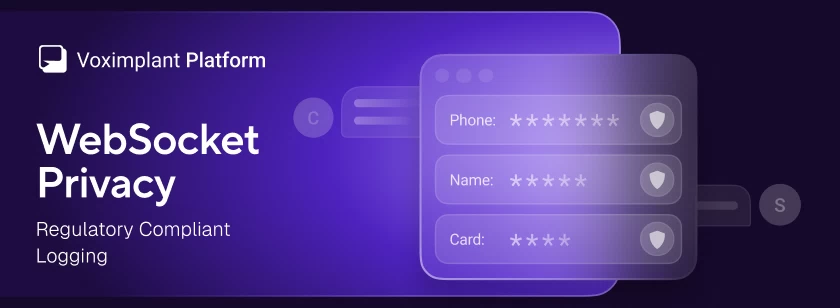
Voximplant has added a WebSocket privacy option that redacts message payloads from logs across all WebSocket-based services – Voice AI connectors and external speech system – and speech control modules
2026-04-232744
Voximplant now lets developers build full-cascade voice AI pipelines in VoxEngine without sacrificing turn-taking quality.
2026-03-265241